What an e-invoice is
Under § 14 (1) UStG, an e-invoice is an invoice „die in einem strukturierten elektronischen Format ausgestellt, übermittelt und empfangen wird und eine elektronische Verarbeitung ermöglicht“ ("that is issued, transmitted and received in a structured electronic format and allows electronic processing"). A PDF file without embedded data does not count; a ZUGFeRD file does. The BMF (Federal Ministry of Finance) explicitly classes PDF files without embedded data as „sonstige Rechnungen“ ("other invoices"), just like paper. The main e-invoice formats are XRechnung and ZUGFeRD from version 2.0.1, except in the MINIMUM and BASIC WL profiles.
There are transition periods for issuing until the end of 2027, but none for receiving: since 1 January 2025, every business in Germany has to be able to accept an e-invoice, and an email inbox is enough for that (BMF letter of 15 October 2024, para. 40). In our view, though, the inbox is only half the answer. With ZUGFeRD, the embedded XML is the invoice, not the PDF view (BMF FAQ, question 12a). If you receive e-invoices, you also need to be able to read the XML.
E-invoicing mandate: what applies when
since 1 January 2025
Receiving
All businesses in Germany must be able to accept e-invoices.
Supplies in 2027
Issuing, stage 1
Paper and PDF only with a previous year's turnover of €800,000 or less.
Supplies from 2028
Issuing, everyone
E-invoices between businesses in Germany, exceptions below.
| Supply made | Receiving | Issuing |
|---|---|---|
| Supplies in 2025 and 2026 | Must be able to accept e-invoices (mandatory since 1 January 2025); an email inbox is enough | Paper always allowed, PDF with the recipient's consent |
| Supplies in 2027 | as before | Paper or PDF only if the previous year's turnover was €800,000 or less |
| Supplies from 2028 | as before | E-invoice mandatory, exceptions below |
Exempt from issuing are small-amount invoices up to €250 (§ 33 UStDV), tickets (§ 34 UStDV) and invoices from a Kleinunternehmer (small business under § 19 UStG) (§ 34a UStDV). Kleinunternehmer still have to receive them; the details are in E-invoicing for small businesses. The mandate does not apply to invoices to private individuals. Whether an exception applies to you is something to settle case by case with your tax adviser.
Does it affect me?
Your deadline in two clicks
Who do you invoice?
Choose on the left. The result appears here.
Simplified overview based on § 27(38) UStG, §§ 33 to 34a UStDV and the federal E-Invoicing Ordinance (ERechV). What counts is when the supply was made; a tax adviser clarifies individual cases.
What the BMF letter of 15 October 2026 adds
The third BMF letter on e-invoicing changes no deadlines. It settles practical questions, including:
- Description of the supply: the type, scope and nature of the supply, and where relevant the place, must be in the structured part of the e-invoice, not just in an attachment (paras. 10 to 12). Further details such as timesheets may go in an embedded attachment.
- Down-payment, advance and interim invoices that you issue before your obligation starts do not have to be e-invoices, even if the supply and payment come later (para. 2).
- Invoices based on gross prices: until 31 December 2027, totals per tax rate with the tax amount are enough in the structured part, as long as an embedded attachment contains the individual line items (paras. 17 to 19).
- If you correct an e-invoice, you must send the correction as an e-invoice too (paras. 20 and 21).
XRechnung or ZUGFeRD?
An XRechnung is a pure XML file; a ZUGFeRD invoice is a PDF with embedded XML. Both count as e-invoices, ZUGFeRD from version 2.0.1 and not in the MINIMUM and BASIC WL profiles. Invoices to federal authorities are generally sent as an XRechnung with a Leitweg-ID (the buyer's routing ID); between businesses, both formats are allowed. You read an XRechnung with an XRechnung viewer; with a ZUGFeRD invoice, a PDF program shows only the view, not the XML. We tested our XRechnung viewer with all 86 test invoices in the KoSIT XRechnung test suite.
rechnung-2026-004.pdf (PDF/A-3)
PDF view
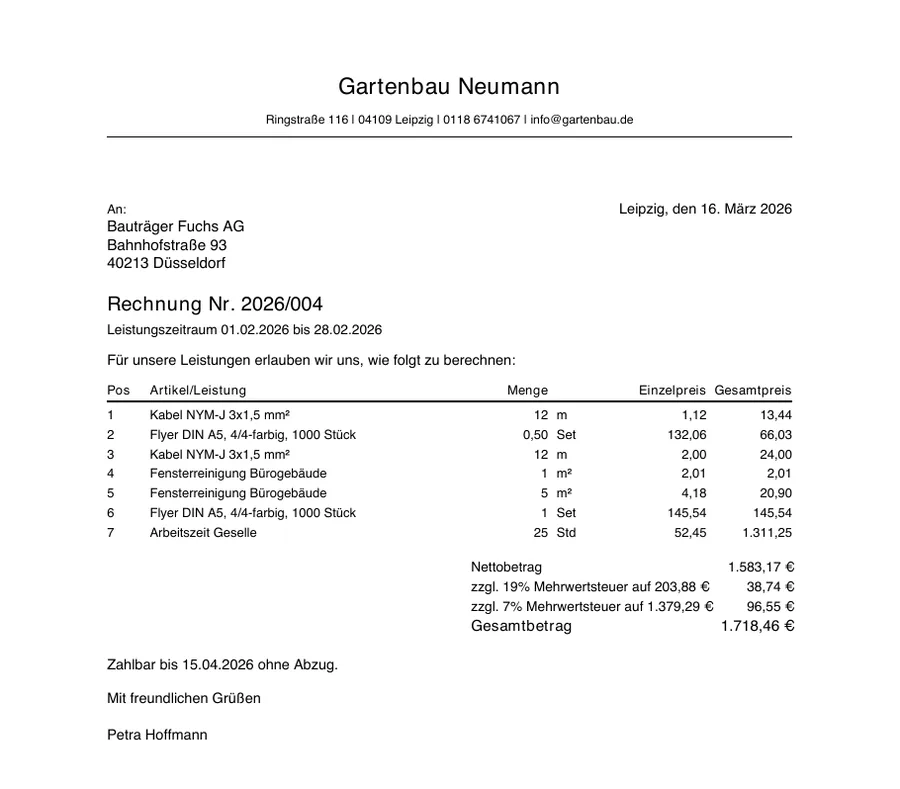
For people. Not authoritative since 2025.
Embedded XML (CII)
factur-x.xml
<rsm:CrossIndustryInvoice …>
  <rsm:ExchangedDocument>
    <ram:ID>2026/004</ram:ID>
    <ram:TypeCode>380</ram:TypeCode>
    <ram:IssueDateTime>
      <udt:DateTimeString format="102">20260316
  …
  <ram:SellerTradeParty>
    <ram:Name>Gartenbau Neumann</ram:Name>
  <ram:BuyerTradeParty>
    <ram:Name>Bauträger Fuchs AG</ram:Name>
  …
  <ram:PayeePartyCreditorFinancialAccount>
    <ram:IBANID>DE05528820018263304348
  …
  <ram:TaxBasisTotalAmount>1583.17
  <ram:TaxTotalAmount currencyID="EUR">135.29
  <ram:DuePayableAmount>1718.46
For software. This is the invoice.
Which ZUGFeRD profiles count, which format each recipient expects and how the same invoice differs between the two formats is covered in the guide XRechnung or ZUGFeRD.
Retention: the XML, for eight years
Since the Fourth Bureaucracy Relief Act (Viertes Bürokratieentlastungsgesetz), invoices must be kept for eight years instead of ten (§ 14b UStG). For an e-invoice, the structured part, that is the XML, must be kept in its original form. A printout or a PDF generated from it does not replace it.
- Submitting an XRechnung via OZG-REAccount, transmission channels, formats, mandatory details and common errors on the federal and state invoice platform.
- erechnung.new or pdfveraEffort, formats, prepayment and check report, compared with three public KoSIT test invoices.
- E-invoicing for small businesses (Kleinunternehmer)Must receive, may issue: § 34a UStDV, freelancers, private customers, public bodies and what goes into a voluntary XRechnung.
- XRechnung or ZUGFeRD?Differences, profiles, who expects which format, and the same invoice in both formats, tested.